
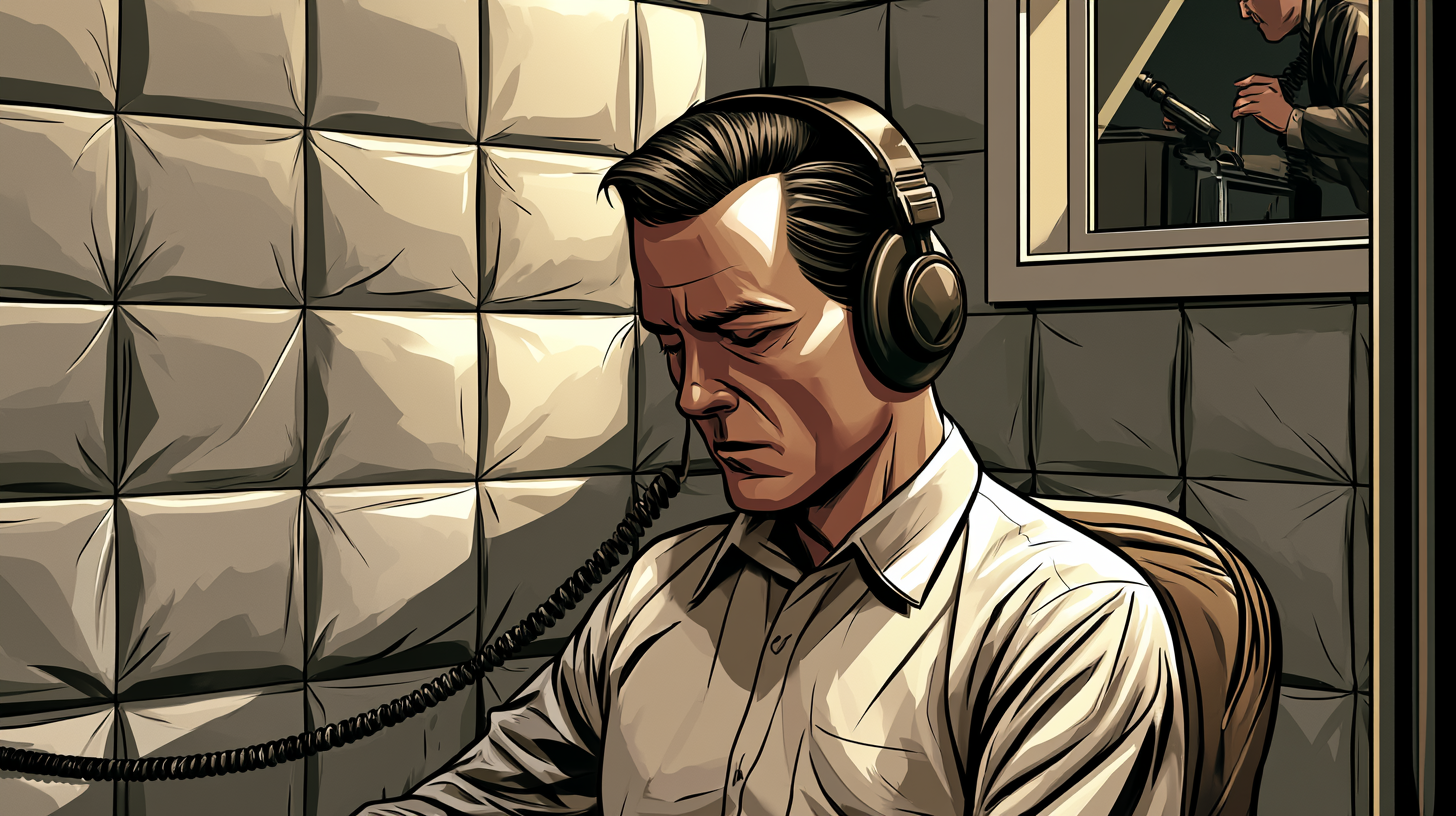
Did you know that actor Jake Gyllenhaal is legally blind? He has 20/1250 uncorrected vision, was born with a lazy eye that naturally resolved, and has worn intensive corrective lenses since he was six years old. In an interview with The Hollywood Reporter, he called the condition advantageous, saying he has known nothing else. His corrected vision has been reported at 20/200, placing him at the federal threshold.¹
"Legally blind" has been a thing since before our grandfathers were in diapers. The Social Security Act first used it to identify blind persons as a federal category in 1935.² A clinical threshold followed in 1954, later refined in the 1967 amendments to central visual acuity of 20/200 or less in the better eye with best correction, or a visual field of 20 degrees or less—standards still in use today.³ It also appears in Sections 216(i)(1) and 1614(a)(2) of the Act and has been codified into the Code of Federal Regulations at 20 CFR § 404.1581.⁴ ⁵
Congress has recognized blindness as a disability for over ninety years. The specific clinical threshold has been in place for half that. What that means is that there's an infrastructure so extensive that few people, including few who benefit from it, have ever kept track of how far it can reach.
Yet, there is no equivalent for hearing loss. The phrase "legally deaf" does not exist in the eyes of the federal government. There's no clinical threshold, no tax deductions, or consistent measure for tracking.
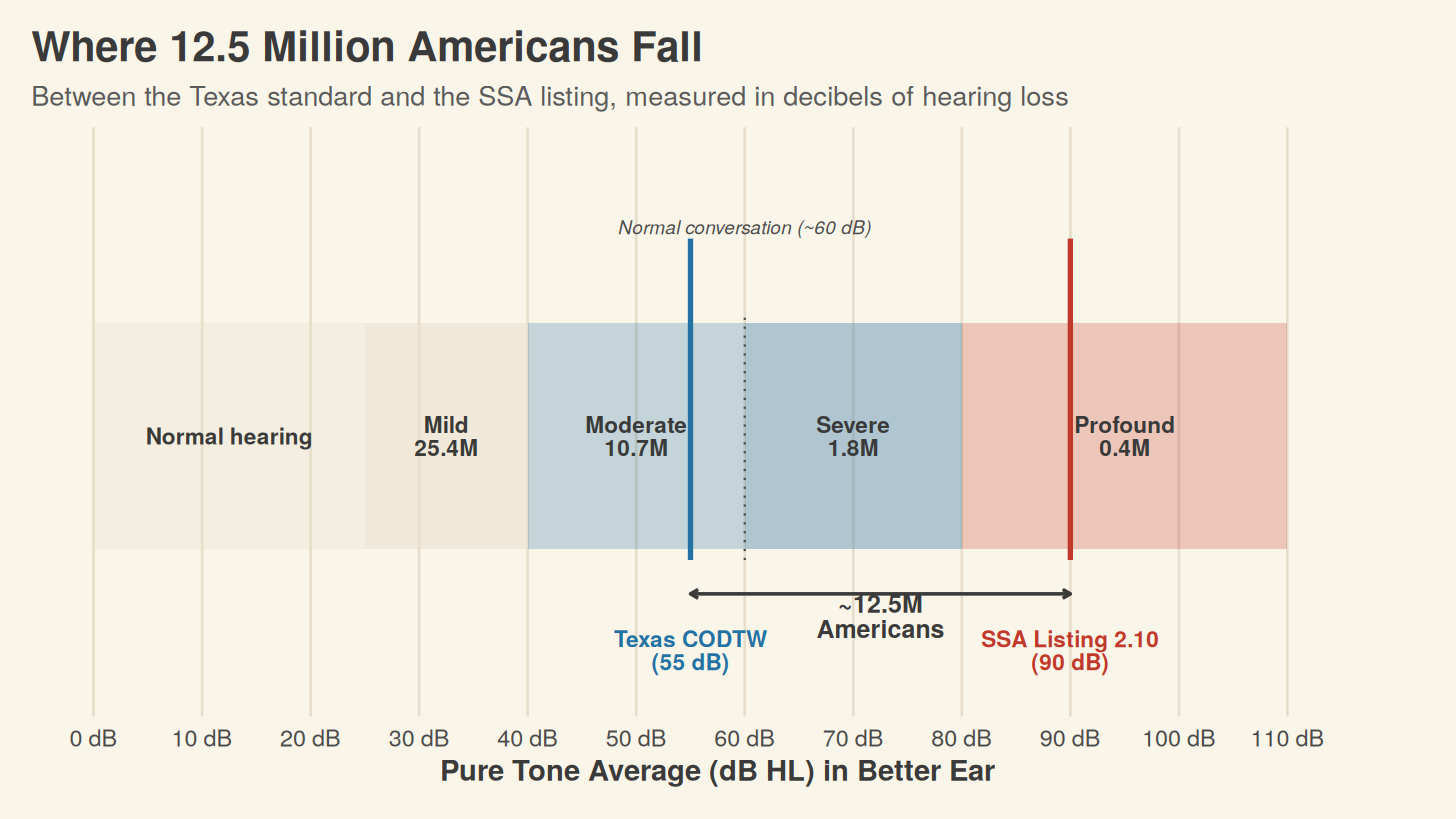
Right now, I am looking at a form that's sitting on my desk. It's the Texas HHSC Form 3900, the Application for Certificate of Deafness for Tuition Waiver.⁶ (Graduate school is expensive, so don't judge me.) To qualify, I have to prove functional deafness through one of four criteria: an unaided pure tone average of 55 decibels or greater in the better ear across 500, 1000, 2000, and 4000 Hz; an aided average of 30 dB or greater at those same frequencies; speech discrimination below 50 percent; or other disabling conditions verified by a physician.⁶ Texas knows how to draw a line in the sand for a benefit (tuition exemption under Texas Education Code § 54.364), and they even have a process around it.⁷
If a state can do that, why can't the country?
Let's start with Social Security. The SSA maintains a separate listing for statutory blindness that creates a streamlined disability determination with presumptive eligibility. Hearing loss goes through the general evaluation process under Listing 2.10, which requires either an air conduction hearing level of 90 decibels or greater in the better ear combined with a bone conduction level of 60 dB or greater, or a word recognition score of 40 percent or less.⁸ Those criteria describe profound deafness. For comparison, the Texas tuition waiver standard is 55 dB—the level at which normal conversation (typically around 60 dB) sits at the edge of perception.
Using NHANES data from 2001 through 2010, Goman and Lin estimated that 10.7 million Americans aged 12 and older had moderate hearing loss (pure tone average above 40 dB through 60 dB in the better ear), and another 1.8 million had severe loss (above 60 dB through 80 dB).⁹ Nearly all of those 12.5 million people would meet the Texas tuition waiver standard. Almost none would meet SSA Listing 2.10. The fact that there's no updated severity-stratified estimates is part of the problem.
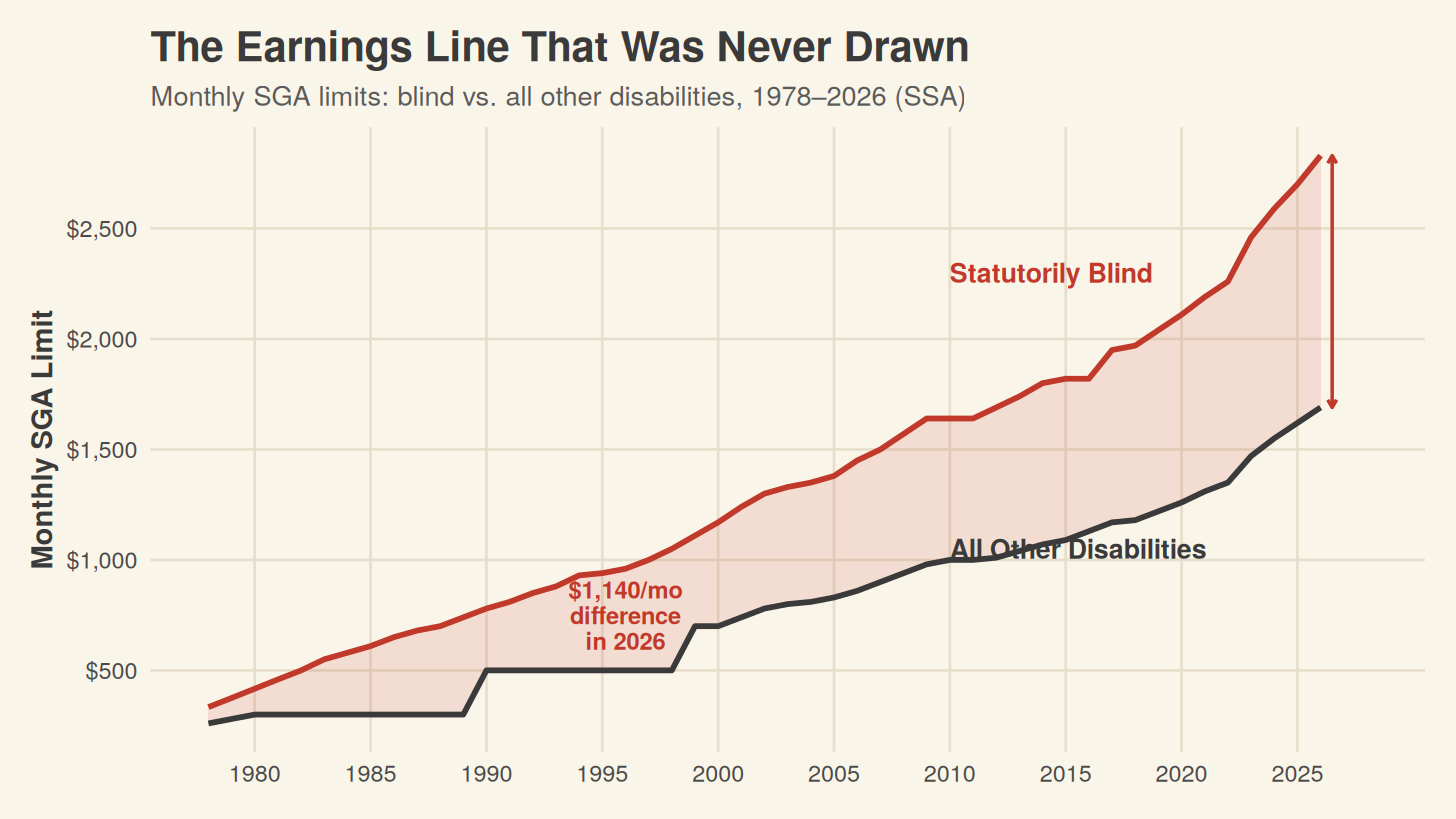
The earnings disparity puts a dollar figure on it. In 2026, a statutorily blind SSDI recipient can earn up to $2,830 per month before their benefits are affected. Every other disability category, including profound hearing loss, caps at $1,690 per month.¹⁰ That is $1,140 per month, $13,680 per year, in allowable earnings that a deaf worker loses compared to a blind worker with the same severity of disability. Over a decade, the cumulative difference reaches $136,800. The disparity has nothing to do with the severity of hearing loss, but with the fact that a category was never created.
The tax code runs the same way. Legally blind individuals receive an additional standard deduction of $2,050 per year if unmarried, or $1,650 if married filing jointly.¹¹ There's no equivalent deduction for hearing loss at any severity. For a single filer in the 22 percent bracket, that adds up. You can't extend the deduction because the administrative category does not exist.
Epidemiological surveillance breaks down the same way. Federal and international bodies using cutoffs of 25, 35, and 40 dB produce wildly different population estimates.¹² ¹³ ¹⁴ ¹⁵ ¹⁶ The legally blind definition imposed a single measurement standard on vision loss in 1967 and that number has not moved. Nothing comparable constrains hearing loss estimates, which means the deaf and hard-of-hearing population is everywhere and nowhere in federal datasets.
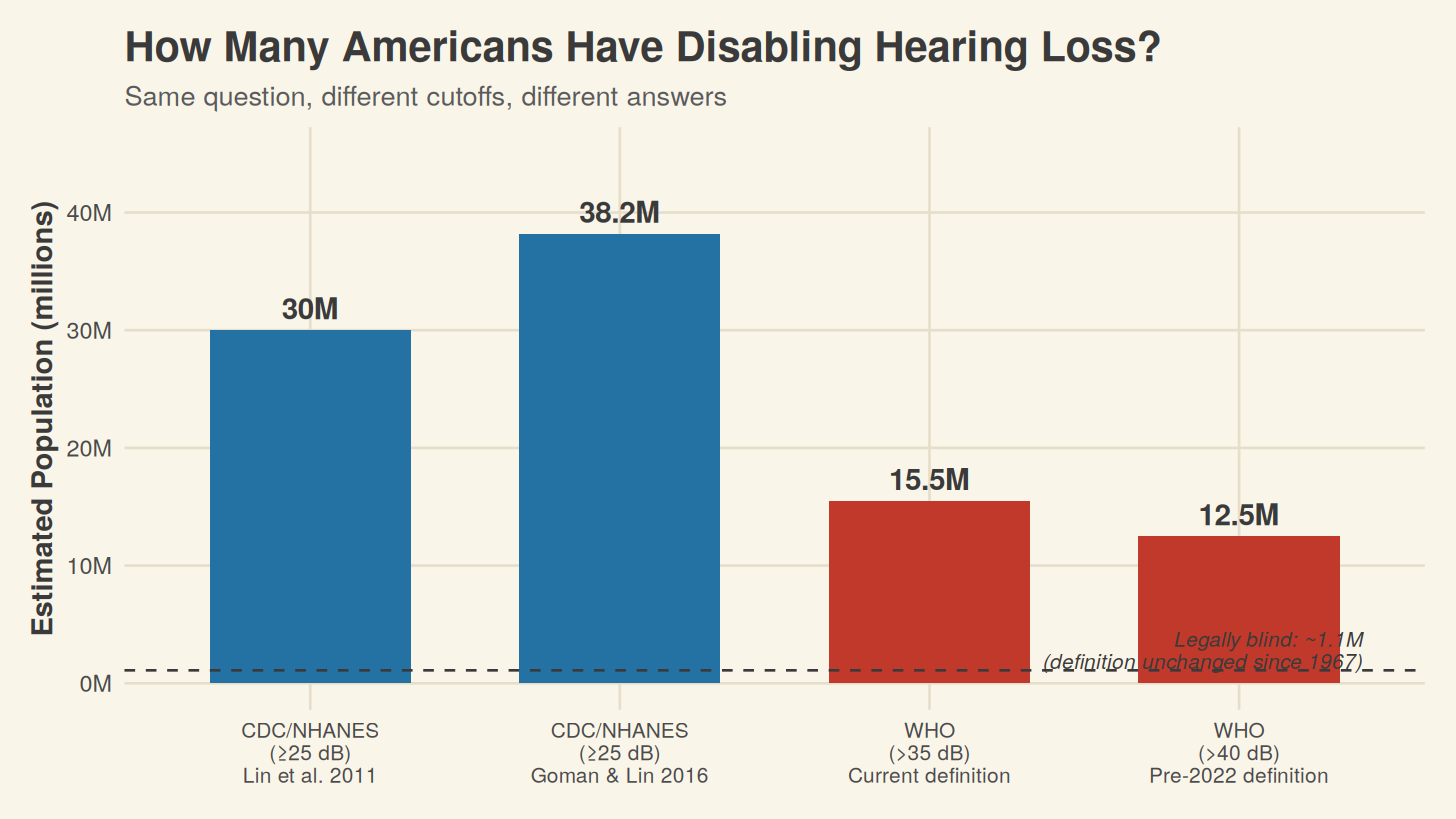
Funding follows counting. The blind community has a number anchored to a legal definition. For the deaf and hard-of-hearing population, the equivalent is a range of estimates that shift depending on the source.
A federal threshold would not fix the counting problem overnight, but it would create the precondition for fixing it. Once a set of guidelines exist, federal surveys can adopt them, claims data can flag them, and state registries can track them. The legally blind threshold created a countable population. A legally deaf threshold would do the same.
I am not criticizing the blind community. They identified the structural prerequisite and went with it. My issue is directed at the systems and institutions that never did the same for hearing loss, and the advocacy infrastructure that never demanded it.
The argument against a legally deaf standard is usually that hearing loss is too complex for a single number. Two patients with identical pure-tone averages can have wildly different speech discrimination scores. Frequency patterns matter; comorbidities matter. The objection is worth looking at. But its conclusion does not follow the evidence.
Vision loss is not that straightforward either. The 20/200 standard captures central acuity; the visual field criterion adds a second axis. Texas has already solved the multi-axis part for hearing with its CODTW criteria.⁶ The pure-tone-average-only argument falls apart because Texas did not rely on pure-tone averages alone. Audiologists have standardized the necessary measurements. Framing the science as the bottleneck has insulted the profession for decades.
The coding infrastructure makes the omission obvious. ICD-10-CM has a specific billable code for legal blindness: H54.8.²¹ The code exists because the federal definition exists. Hearing loss codes across H90 and H91 capture type and laterality but lack an equivalent administrative trigger. Without a federal definition, the codes sit there inert.
A bright-line threshold would not eliminate ADA protections for people below the line. The legally blind standard did not produce that outcome for vision. It added a presumptive pathway above the line without removing the functional-impact pathway below it.
The Deaf community identity concern is harder. Some may resist a medicalized federal standard that defines deafness through decibels rather than cultural belonging. I am not dismissing this. But a threshold would be an administrative and benefits tool operating in its own lane. Having a legally blind standard did not erase blind identity or community. The two frameworks can coexist.
The dismissal of any single downstream benefit in isolation is weak. The tax deduction is modest on its own, but the SGA disparity dwarfs it, and the epidemiological and funding effects dwarf both. The omission is structural, and its costs are cumulative.
The Hearing Loss Association of America and National Association of the Deaf do important work under real constraints. But a campaign for a "legally deaf" federal standard does not appear in their priorities. Every one of their fights—captioning, insurance, ADA enforcement—would be structurally easier if the foundational threshold existed. The National Federation of the Blind identified the prerequisite and went after it. Why haven't the major hearing loss organizations done the same?
I know what living with 55+ decibels of loss sounds like. Normal conversation is right at the tippy-tip of perception without amplification. In noise or with multiple voices, everything blurs into static. Speech discrimination below 50 percent means half the words don't land.
Here is what a federal definition could look like, modeled on the Texas CODTW and structured to parallel the legally blind standard: unaided PTA of 55 dB HL or greater in the better ear (averaged across 500, 1000, 2000, and 4000 Hz), supplemented by best-aided PTA of 30 dB HL or greater, or word recognition score below 50 percent, plus a clinical judgment pathway. This is conceptual (the exact thresholds would need consensus and legislation) but the framework already exists at the state level. Texas has proved it.
A legally deaf threshold would not replace the ADA's flexible framework or define cultural Deaf identity, but it would build the floor that every other fight must stand on.
The form is still on my desk. Jake Gyllenhaal is legally blind, and the infrastructure for him has been around since the Depression. I am legally nothing. The equivalent designation for my disability was never created. The form is a state's workaround for a federal absence and represents where Texas has decided to draw the line. The clinical science supports it. The classification system has the codes.
I am going to fill it out.
References
- Olsen E. Jake Gyllenhaal on his eyesight. The Hollywood Reporter. June 2024. Accessed June 2026. Corrected vision of 20/200 reported by IANS (June 6, 2024) and Prokerala. Secondary reporting: Fox News, Hello Magazine, PopCulture.
- Social Security Act of 1935 (H.R. 7260). National Archives. https://www.archives.gov/milestone-documents/social-security-act. Full text available at https://www.ssa.gov/history/35act.html
- Social Security History: Special provisions for the blind. Social Security Administration. https://www.ssa.gov/history/ssa/lbjdib1.html
- Social Security Administration. Statutory blindness: Title II and Title XVI. POMS DI 26001.001. https://secure.ssa.gov/poms.nsf/lnx/0426001001
- 20 CFR § 404.1581. Meaning of blindness as defined in the law. https://www.ssa.gov/OP_Home/cfr20/404/404-1581.htm
- Texas Health and Human Services Commission. Certificate of Deafness for Tuition Waiver (CODTW). Form 3900. https://www.hhs.texas.gov/services/disability/deaf-hard-hearing/tuition-waiver
- Texas Education Code § 54.364. Blind, deaf students. https://statutes.capitol.texas.gov/Docs/ED/htm/ED.54.htm#54.364
- Social Security Administration. Listing 2.10: Hearing loss not treated with cochlear implantation. Disability Evaluation Under Social Security, Section 2.00. https://www.ssa.gov/disability/professionals/bluebook/2.00-SpecialSensesandSpeech-Adult.htm
- Goman AM, Lin FR. Prevalence of hearing loss by severity in the United States. Am J Public Health. 2016;106(10):1820-1822. doi:10.2105/AJPH.2016.303299
- Social Security Administration. What's new in 2026. The Red Book. https://www.ssa.gov/redbook/newfor2026.htm
- Internal Revenue Service. Revenue Procedure 2025-32, Section 4.14(3). https://www.irs.gov/irb/2025-45_IRB. See also IRS Topic 551: https://www.irs.gov/taxtopics/tc551
- World Health Organization. Deafness and hearing loss fact sheet. Updated March 2026. https://www.who.int/news-room/fact-sheets/detail/deafness-and-hearing-loss
- American Speech-Language-Hearing Association. Hearing loss in adults. Practice portal. https://www.asha.org/practice-portal/clinical-topics/hearing-loss/
- Hoffman HJ, Dobie RA, Losonczy KG, Themann CL, Flamme GA. Declining prevalence of hearing loss in US adults aged 20 to 69 years. JAMA Otolaryngol Head Neck Surg. 2017;143(3):274-285. doi:10.1001/jamaoto.2016.3527
- Lin FR, Niparko JK, Ferrucci L. Hearing loss prevalence in the United States. Arch Intern Med. 2011;171(20):1851-1852. doi:10.1001/archinternmed.2011.506
- National Institute on Deafness and Other Communication Disorders. Quick statistics about hearing. https://www.nidcd.nih.gov/health/statistics/quick-statistics-hearing
- American Foundation for the Blind. The Unseen Minority: A Social History of Blindness in the United States. Chapter 5: The facts of blindness. "Legal blindness was defined in a formula adopted in 1934 by the American Medical Association, subsequently incorporated in the Aid to the Blind title of the Social Security Act of 1935." https://afb.org/online-library/unseen-minority-0/chapter-5
- Crocker AR. The engine and the fuel. Notes from the Abstracts. March 15, 2026. https://notes-from-the-abstract.ghost.io/the-engine-and-the-fuel/
- Hearing Loss Association of America. Advocacy priorities. https://www.hearingloss.org/advocacy-and-resources/
- National Association of the Deaf. About us. https://www.nad.org/about-us/
- ICD-10-CM Code H54.8: Legal blindness, as defined in USA. 2026 edition, effective October 1, 2025. https://www.icd10data.com/ICD10CM/Codes/H00-H59/H53-H54/H54-/H54.8
All sources verified from primary .gov, .who.int, peer-reviewed journal, or organizational websites.